 Italiano
 English
 Deutsch
 Français
 Português
 Polski
 Български
 Română
 Español
 Русский
 Српски
 Hrvatski
 Slovenski
 Shqip
Shqip Magyar
 English (US)
Steel or aluminium props
For your construction site, is it better to buy steel or aluminum props? A quick guide to the uses of both
In the construction industry, the choice of materials and equipment plays a key role not only for the quality of the end result, but also for the safety, operational efficiency on the worksite and the overall costs of a given project.
With regard to props, conventionally made of steel, in recent years aluminium props have become increasingly widespread on worksites due to their characteristics.
To fully understand the differences in use between aluminium props and steel props, let's start with the inherent properties of the two metals that the two types of props are made of.


Steel and aluminum
Steel is an alloy predominantly consisting of iron and carbon (typically less than 2 %) known for its high mechanical strength, stiffness and durability. It is conventionally used in construction due to its ability to withstand high loads and its strength.
Aluminium, on the other hand, is a lightweight metal, with excellent resistance to corrosion, good mechanical strength (especially in structural alloys) and a significantly lower density compared to steel. This density difference is one of the key factors which determine the operational benefits of aluminium props.
One of the main advantages of aluminium props lies in their low weight. The specific weight of steel, depending on the type of steel and its chemical composition, is between 2.5 and 3 times heavier than that of aluminium.
Considering a higher initial purchase cost, aluminium props therefore enable to save throughout their use as shown below.
Main advantages of aluminium props
- Easier to transport: the lightweight aluminium props are easier to handle by hand, reducing the need for machines or multiple operators.
- Assembly speed: its lightweight design allows for faster installation, increasing worksite productivity.
- Less operator fatigue: less demanding physical effort, hence beneficial to occupational safety.
- Easier adjustment: often designed with advanced telescopic systems, they allow for quick and precise adjustments.
- Greater extensions: unless special steel props are built beyond standard sizes (and therefore higher design and construction costs), aluminium props reach greater extensions that enable them to be used on construction worksites for building large structures.

Corrosion resistance of aluminium props
Another pro of aluminium worthy highlighting lies in its natural resistance to corrosion.
This due to the spontaneous formation of a thin waterproof and adherent oxide layer (whose chemical formula is Al2O3), which protects the underlying metal and makes it actually stainless in environments with pH between 4 and 9.
This ensures a significantly longer duration in outdoor environments, basically no maintenance, and no additional protective treatment is required over time. The aesthetic and functional degradation over time is therefore very little compared to conventional steel props.
However, there may still arise the need to provide an additional protection layer for utmost safety, usually painting which also has the secondary function of visual recognition of the props should they be used on mixed construction worksites.

Cost comparison
From an economic point of view, drawing comparison between bearing an investment for the purchase of aluminium and steel props can be quite complex. Although aluminium props definitely have a higher initial cost, they may be the best choice in the long-term depending on the specific needs of the project intended to be carried out.
Besides the advantages mentioned above on their lightweight traits (lower transport costs due to lower weight, reduced maintenance and easier to handle for manpower), aluminium props with the same extension have superior mechanical strength and, above all, significantly higher load capacities.
When used with connection frames, aluminium props can withstand loads up to 90 kN.
The aluminium props when connected to the respective frames can also be used as tower support scaffolding, thus greatly extending the operating heights that would otherwise be unattainable with steel props.
This entails, in order to withstand a given load, having to use significantly fewer aluminium props than would be necessary if they were made of steel, if not the only feasible operational solution in the event of significant heights.
Therefore, in the long term, aluminium props may be more cost-effective, especially on construction worksites where the use of steel props would require solutions beyond the standard sizes conventionally used.
Drawing final conclusions, the use of aluminium props is a modern and efficient solution in the construction industry. The main advantages compared to steel props lie in their light weight, ease of use, resistance to corrosion and operational efficiency. These factors result in increased productivity, reduced risk for workers and, in many cases, long-term cost-effectiveness.
However, steel continues to play a key role in applications that require high strength and load-bearing capacity. Therefore, when choosing between the two materials, one must carefully take into account the specific needs of the project.
Ultimately, although aluminium props are not a complete replacement for steel props, they are a highly viable and, in many cases, preferable alternative, depending on the specificities of the work they are intended to carry out.
After reading this overview of steel and aluminium props and their uses, have you found a solution to your problems that you might not have realised existed? Or are you a business looking for a supplier of various types of props, suitable for a wide range of applications? Or perhaps you have some questions, or would like further information about our products beyond what is available online?
Contact us at: sales@gbmitaly.com and we’ll provide you with all the information you need!

Ultimo aggiornamento:
#GBM video: tutorial & info
How to build a slab with light duty props: videotutorial

News

Steel and aluminum props

GBM's shipbuilding scaffoldings
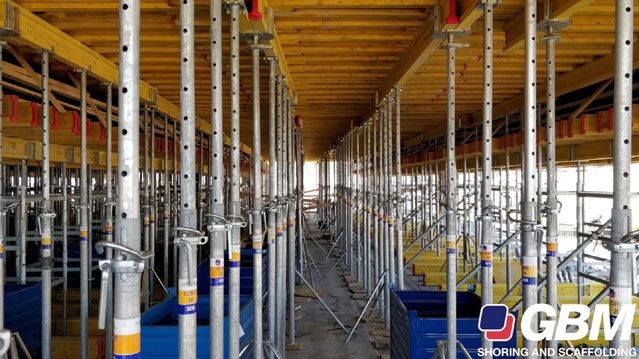
Props required to sustain a slab: guidelines on how to establish distances, classes and quantities.
Kontakte: info, çmime dhe preventiv.
Dëshiron më shumë information mbi produktet GBM? Na pyet për gjithçka!